
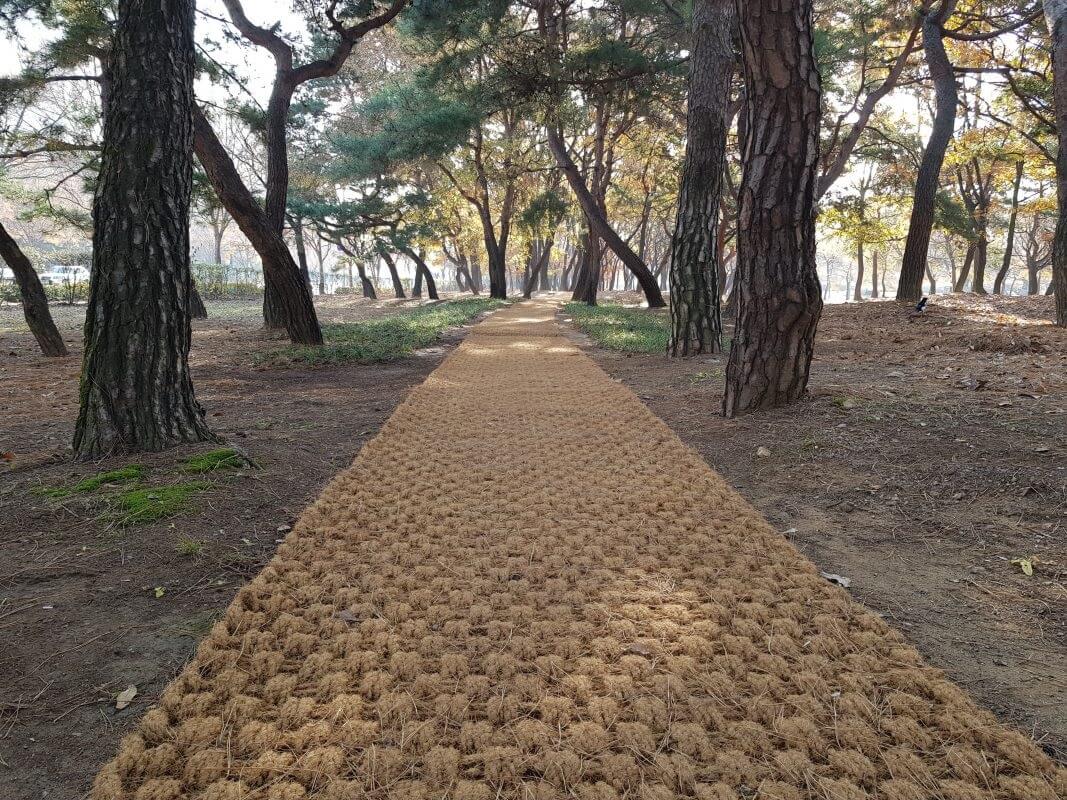
Coir geotextiles in roads – Soil has been used all over the world as a building material for buildings, roads, irrigation structures, etc. Because of the brittleness of tensile and shear strength, the soil needs to be improved according to the work requirements, which are different from one place to another. Soil stabilization has been performed for centuries to improve the properties of soil engineering. The initial stabilization method involves mixing the soil with soil of higher strength or binding materials such as limestone/cement/calcium or reinforcement with suitable elements/fibers.
Roads laid on BC soil bases create ripples on the road surface due to loss of substrate strength due to softening during monsoons. British Columbia’s soil is very clayey and presents a problem for road engineers. If dried, it shrinks and becomes too hard for the blocks to be easily crushed for processing in road construction. However, when wet during rain, they swell, lose their strength and pose a serious problem in terms of subsequent road performance. All these results are cracks in the streets, so road engineers do not favor road construction. in British Columbia soils, but there is no choice because black cotton soils are available in about a third of the country. It is often impossible to build a stable base course over a soft substrate without losing the expensive foundation materials that penetrate the soft substrate soil; Therefore, the soil improvement method should be used.
From Biodegradable Materials Coir Geotextiles Made For
Coconut geotextiles make up one of the largest groups of geosynthetic products. One of the most common applications of geotextiles is the construction of sidewalks and dams in soft soils. They are materials in the traditional sense, consisting mainly of manufactured fibers. However, natural fibers are also used in manufacturing.
Coconut geotextiles are produced by crushing coconuts using a shredder to create a small piece of coconut. The coir is then spun using a spinning device to make coir rope. The diameter of the coir rope can be adjusted as needed. After the rope is formed, the coir ropes are woven to resemble a net. The thickness of this net can be adjusted as needed.
The materials needed to make geotextiles from coir are cheap and easy to find. Engineering uses coconut fiber geotextile as an overlay or interlayer for the road. It can protect the surface runoff water flow, dam reinforcement, filtration and drainage.
The use of Coconut Geotextiles in Paving Roads
Coconut coir geotextiles or coir nets are spread directly over the area to be used as roads. First, the ground is almost flat, and then a coconut net is spread over it. Coconut geotextiles are an alternative paving solution because they are made from natural materials. The material is strong but can be degraded by soil action. It is safe for the soil ecosystem. It is compared to a mixture of lime, cement, etc.
Soil nutrient improvement uses coir geotextiles after they decompose. It becomes a nutrient and beneficial substance for plant growth. Method application of coconut geotextiles has been successful in highly compressed areas and sloping soils. It is also used for road embankments and lands at risk of erosion and erosion.
Maybe you like to read the following article Working on Making Space Building Crafts from Used Bottles That are of High Value