
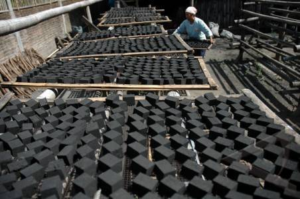
Charcoal briquettes Indonesia – Did you know that the coconut, also known as cocos nucifera, is a versatile plant widely grown in Asia and the Pacific? Indonesia is the world’s largest coconut producer, with 19.4 million tonnes produced in 2017. The Philippines and India were second and third, producing 15.9 million and 10.6 million tonnes respectively.
The fruit of the coconut is the commonly used part and is processed into various by-products such as copra, desiccated copra, coconut charcoal, coconut fiber and coconut sugar. Coconut products such as coconut oil, virgin coconut oil (VCO) and coconut milk are also produced for domestic and export demand. Some of these products have become exports and generate large amounts of foreign exchange.
Although Indonesia is the world’s largest coconut producer, its export value and products are nowhere near that of the Philippines. Indonesia can produce less than a third of the $757.3 million in Philippine exports. This export value corresponds to the amount of processed coconut products created. Indonesia only has 25 products while the Philippines can produce 125 products.
Export of Charcoal Briquettes Indonesia Potentially Positive from Year to Year
One processed coconut product that has become an Indonesian export is charcoal briquettes made from coconut husks. These briquettes are made by compressing charcoal from burning coconut shells. The product is in great demand as it is an environmentally friendly alternative fuel, with no waste and no combustion fumes. In addition, this product also generates more heat than charcoal briquettes.
Indonesian coconut shell charcoal is in great demand abroad. According to Kasdi Supagiono, director of the Plantations Department at the Ministry of Agriculture, the product is widely exported to China, Brazil, Germany, Lebanon, Malaysia, Holland, Russia, Saudi Arabia, Sri Lanka and Vietnam. Indonesia exported 188,050 tonnes of coconut charcoal briquettes worth $145,090,000, according to data processed by the General Directorate of Plantations of the Central Statistical Bureau (BPS) in 2019.
Other countries using Indonesian coconut shell charcoal products since 2018 are South Korea and Sri Lanka. According to Agus Andiani, director of PT Perusahaan Perdagangan Indonesia (PPI) Persero, exports are estimated at around 10,000 tonnes and 1,000 tonnes per country, respectively. This product is sourced from coconut shell charcoal products in Sumatra, West Java, East Java and Sulawesi.
Conclusion
With the exception of the above-mentioned countries, this product occupies a dominant position in the Egyptian market, accounting for 84.72% of Egypt’s total coconut husk charcoal imports worth US$1.34 million. According to data from the Egyptian Statistical Agency (Capmas), from January to November 2019, Egypt imported coconut husk briquette worth USD 1.13 million from Indonesia, an increase of 43.48% year-on-year previous.
Indonesian entrepreneurs are taking advantage of this high demand with companies like PT Karbon Tionin Semesta and entrepreneurs from Poewali Mandar, West Sulawesi, Sudirman exporting their products to various countries such as China, Jordan and Egypt.
You may like to read the article about Coir Roll Matting use to Embankment in Shoreline and Riverbanks